|
When George Petrik arrived in the United States, Ronald Regan was an ambitious governor preparing to run for president. At that time, the Republican Party looked quite different than it does today. It was the twilight of the Cold War and the genesis of the neo-conservatism movement.
George and his family were smuggled out of Czechoslovakia and into Austria in July of 1979. They immigrated to the United States shortly afterward, and George started the fourth grade when his family arrived in California. He didn’t speak any English.
“At first, it was very difficult for my brother and me,” he said while recalling his experience. “We didn’t know anyone; we didn’t speak the language. It was terrifying.”
By the end of that year, however, George could speak English. He went on to be very successful in academics and graduated valedictorian from El Modena High School in Orange. He then went on to study business at Chapman University.
“I always identified with the Republican Party because of my experiences. I worked to and struggled to achieve what I did. I never wanted to be a victim. I always wanted to pull my own weight.”
|
|
|
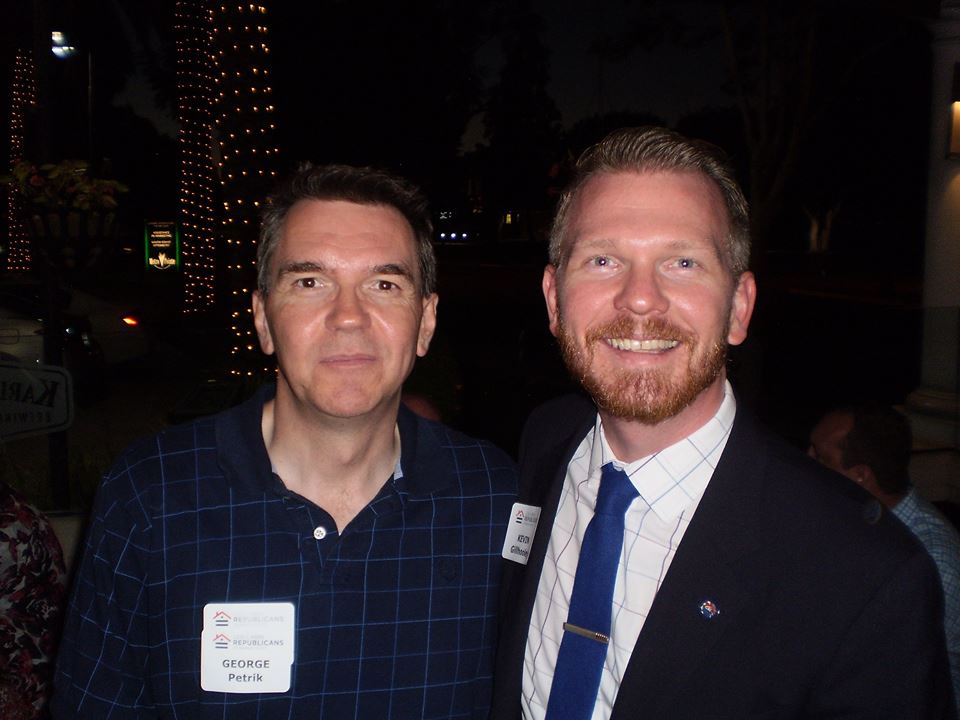
| George Petrik (left) and Kevin Gilhooley (right) at a Log Cabin event.
Photo courtesy of George Petrik. |
What he didn’t identify with were the social stances that the national party took on social issues. The 1994 election that swept Republicans into a majority in both the House of Representatives and the Senate was one indicator of his incongruous sentiments about the party.
“It felt very closed,” he said. “It felt very negative, very anti-immigrant.”
It also felt very anti-gay. George began coming out in the mid-1990s, and it became increasingly difficult to reconcile his political views on economic and foreign policy with the party’s more socially conservative platform. It would be something he would struggle with until he joined the Orange County chapter of the Log Cabin Republicans last year.
“The Republican Party is in a serious soul search right now,” said the Orange County chapter’s president, Kevin Gilhooly. “We need to stop being the party of old white guys and start looking like our constituencies.”
Gilhooly founded Orange County’s Log Cabin chapter a year ago in response to the 2012 election. The conservative group advocates that gays and lesbians be given equal rights under the law.
“The heartbreak of 2012 was what motivated to become politically active,” Gilhooly said. “I knew I needed to do something in my own way.”
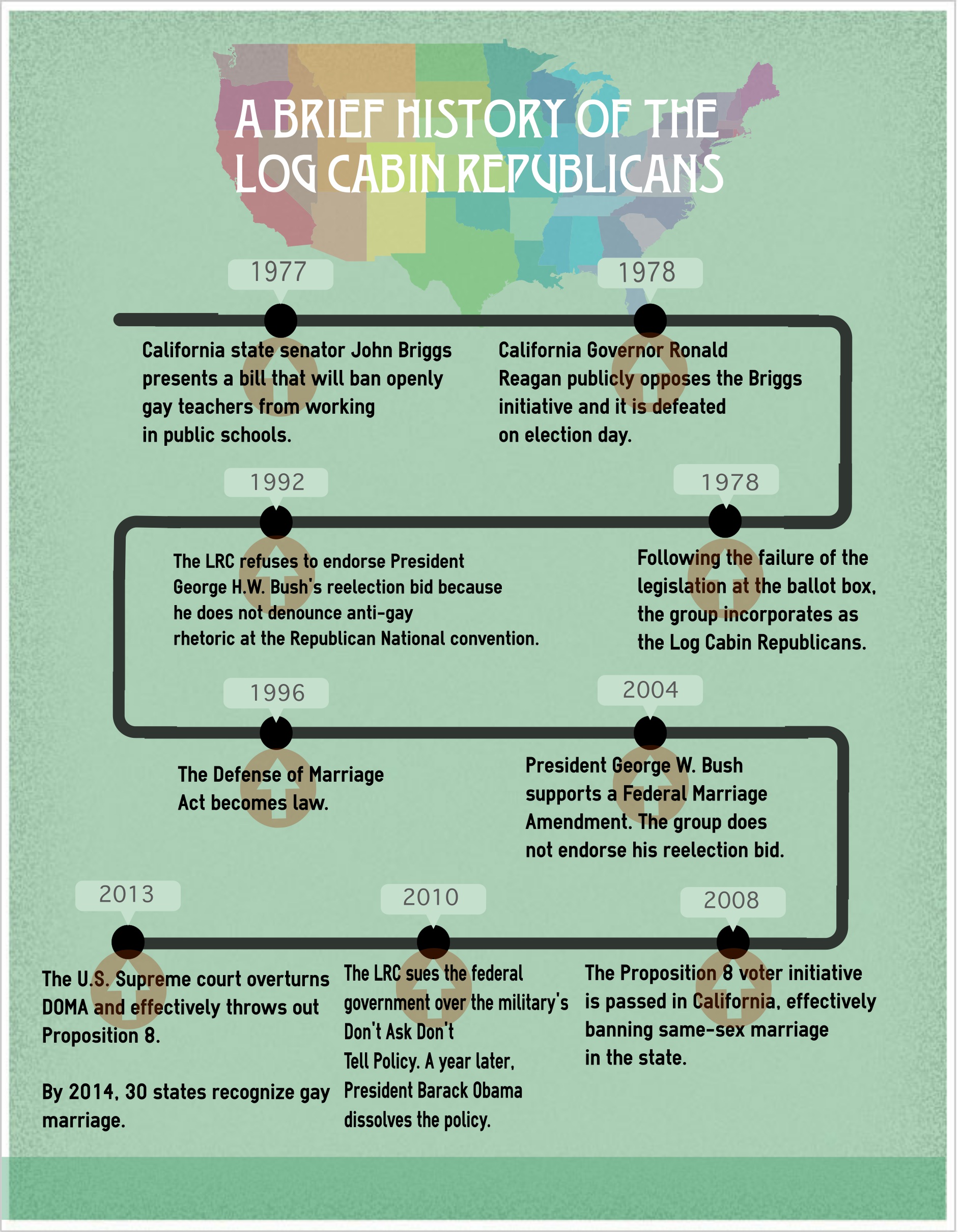
Orange County’s Log Cabin chapter had existed previously, but after President George W. Bush voiced his support for a Federal Marriage Amendment, the group quickly disbanded.
“It all kind of just fell apart,” Gilhooly said. “My understanding is that after President Bush did that, membership in Orange County just dried up.”
Since rebooting the group one year ago, Gilhooly has seen his chapter grow to 80 members. They have at least one meeting each month where they strategize, fundraise and host politically conservative speakers. George Petrik is one of the group’s more active members.
“One of the most refreshing things that I’ve learned while being chapter president is that no one says not to us.” Gilhooly said. “I have to invite a guest speaker for each meeting we have, and no one I’ve invited has ever declined my invitation. We’re a new party.”
The rebirth of the party has been a major theme for the G.O.P. since Mitt Romney lost his presidential bid in 2012. While the former Massachusetts governor lost the popular vote by less than 4 percentage points, his loss in the Electoral College was a landslide, and he trailed President Barack Obama by more than 100 votes.
The campaign that led to election night in 2012 was in part a result of a bitter and protracted primary season that ultimately gave Romney his party’s nomination.
In total, the G.O.P., along with various cable and network news outlets, hosted 20 primary debates over a nine-month period, opening the candidates to a painful level of public and media scrutiny.
During that period of time, several candidates made statements that made national headlines and became infamous memes on the Web and on social media outlets. Former speaker of the House of Representatives Newt Gingrich famously referred to Barack Obama as “the food stamp president.” He also suggested that a top U.S. priority should be creating a colony on the moon. When a gay soldier asked former Pennsylvania Senator Rick Santorum a question about marriage equality who was serving in Iraq, the soldier was boo-ed by the audience before he could finish his question. Texas Governor Rick Perry was ridiculed for having supported in-state tuition for undocumented immigrants who had been brought to the United States as minors.
Mitt Romney was not immune to controversy either. When asked about undocumented immigrants, he introduced the concept of “self-deportation.” On the campaign trail, he insisted that “corporations were people” and in a debate with Barack Obama, he described using “binders full of women” to staff his office while he was governor of Massachusetts. Most infamously, the presidential candidate was caught on camera while speaking a fundraiser referring to 47 percent of Americans as being “dependent upon government,” and believing “that they are victims” who “the government has a responsibility to care for.”
Four months after the election, Reince Priebus, chair of the Republican National Committee, created a report to explain what had gone wrong. The report, titled “Growth and Opportunity Project,” delineated several areas where the party needed to improve and advocated for a $10 million marketing campaign aimed at women, minorities and gays.
It’s a message that hasn’t been lost on Gilhooly or other Log Cabin leaders across the state.
“The issue of marriage equality is over,” said the president of Log Cabin’s San Francisco chapter, Fred Schein. “It’s happening. One of the most important things we need to do as a party now is to eliminate negative language from our platform.”
The negative language he’s referring to is the party’s stance that marriage should only be between one man and one woman.
“California always leads the nation by example. We need to lead by example. People say that platforms don’t matter, but they do. They matter a lot,” Schein said. "It's time that our party get with the program and get with the times."
Other Log Cabin leaders are less forceful about the party’s platform.
|
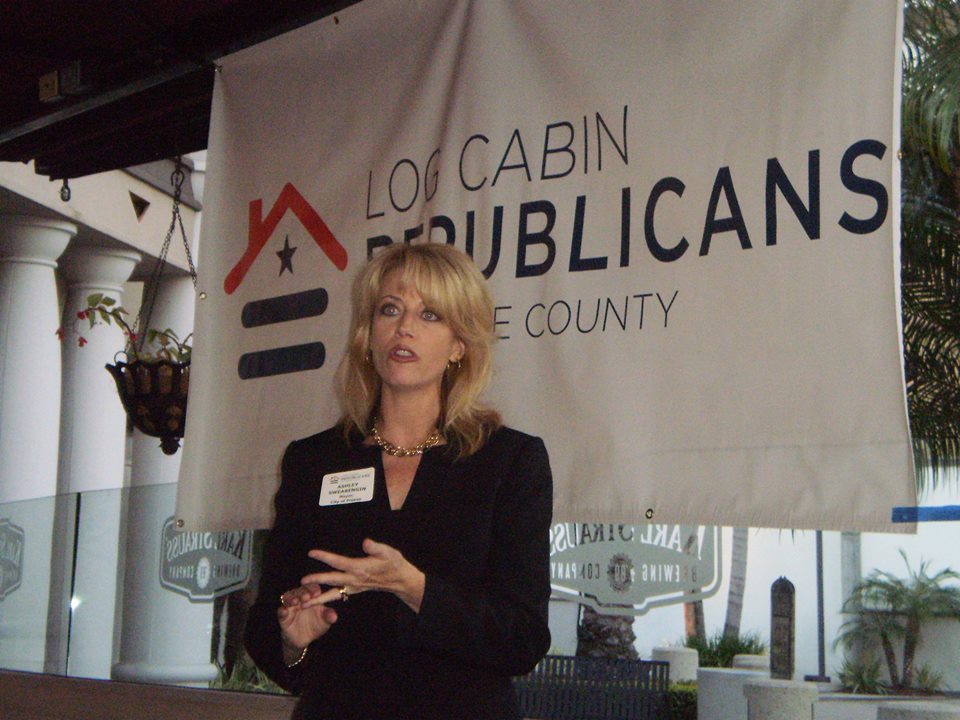
| Ashley Swearengin speaks at the Log Cabin Orange County event.
Photo courtesy of Kevin Gilhooly. |
|
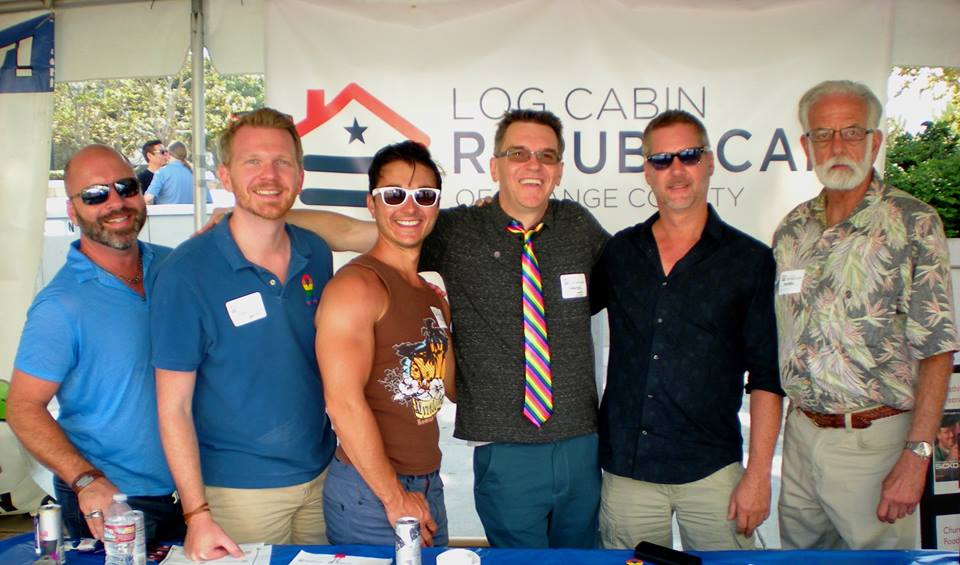
| George Petrik, center, and other members of Orange County's Log Cabin chapter during the O.C. Pride festival. Photo by Gabriel Cortes. |
“It’s a really exciting time to be a member of the party,” said Log Cabin’s Los Angeles chapter president, John Musella. “We have a lot of great, diverse candidates on the ballot, and we should be able to break the super-majority in the state assembly and senate.”
Some of those exciting candidates include Neel Kashkari, a Kashmiri-American running for governor, Janet Nguyen, a Vietnemese-born candidate running for state senate and Mario Guerra, the mayor of Downey who is also running for state senate.
Another candidate many state Republicans are keeping a close eye on is Ashley Swearengin, the current mayor of Fresno who is in a very competitive race for state controller. In a sign of how far the party has come, Swearengin came out in support of marriage equality at a recent meeting of Log Cabin’s Orange County chapter.
“I didn’t know what her views were,” Gilhooly said. “But I was really happy she chose our venue to support marriage equality.”
George Petrik was also very pleased and surprised by what he heard Swearengin say at the meeting. “It’s a step in the right direction,” he said. “The faster we can take these issues off the table the sooner we can get to issues that really matter like taxes and spending.”
One candidate all Log Cabin republicans seem to be extremely excited about is Carl DeMaio, a San Diego County supervisor currently running for Congress. DeMaio is gay, partnered and in a very competitive race.
“Carl is exactly what our party needs to be about,” said Musella. “It’s exciting to see one of Log Cabin’s own doing so well.”
Fred Schein agreed.
“There’s nothing that scares Democrats more than a gay Republican. Actually, what really scares them is gay Republican who can win,” he said.
George Petrik is glad to be so politically active at a time like this.
“I’ve never felt this excited about politics, about the party. We came to this country with nothing. This country embraced me and my family. Now my party is embracing me too.”